Buying Guide
How to Choose a Spotting Scope for Birding and Wildlife
Knowing how to choose a spotting scope helps you get detailed views of distant birds and wildlife, from shorebirds across a lagoon to animals on a far hillside.
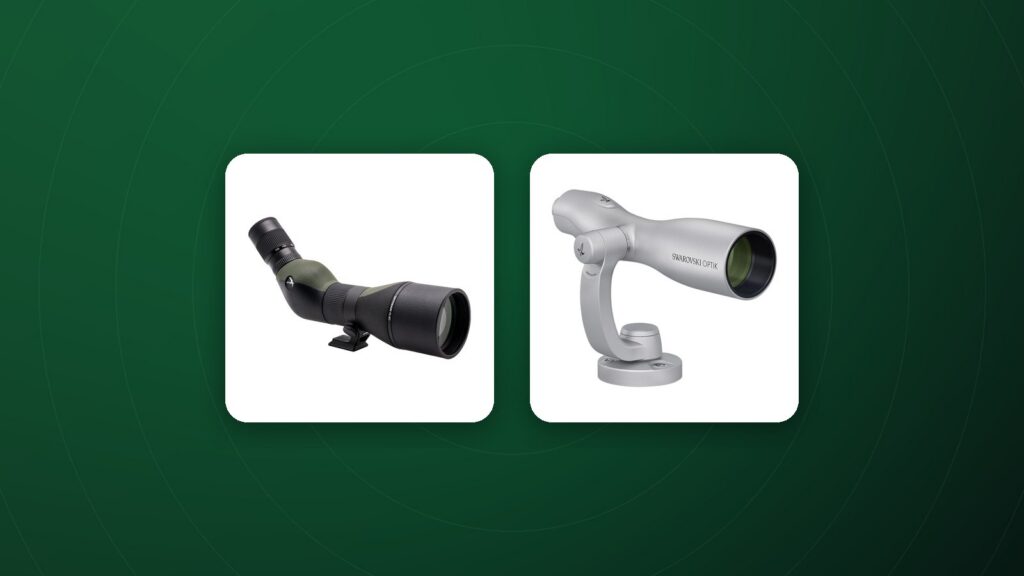
Angled or straight body
Angled scopes have the eyepiece at 45 degrees. They are comfortable for long sessions, easy to share with people of different heights and good for looking upwards. Straight scopes are quicker for finding targets and work well from vehicles or for looking downhill.
Objective lens size
Common objective sizes range from around 50 mm to over 90 mm. Larger objectives give brighter views at higher magnification, especially in low light, but add weight. Mid-size scopes around 65 mm balance brightness and portability.
Magnification and zoom eyepieces
Most spotting scopes use zoom eyepieces, for example 15 to 45x or 20 to 60x. Use the lower end to find subjects and the higher end for detail. Heat shimmer and haze limit useful magnification on warm days.
Glass quality
Extra-low dispersion (ED or HD) glass reduces colour fringing and improves sharpness and contrast, which makes a big difference at high magnification.
A solid tripod is essential
At high magnification, every vibration is visible. Use a sturdy tripod with a smooth pan head so you can follow birds and animals easily.
Digiscoping
Digiscoping means taking photos or video through the scope with a phone or camera. Phone adapters and camera adapters make alignment easier and steadier.
Spotting scopes for different uses
- Birding: angled bodies and ED glass.
- Hunting and target shooting: straight bodies for quick acquisition.
- Travel: compact scopes with smaller objectives.
Weather resistance
Waterproof and fog-proof construction protects scopes outdoors. Lens covers help keep optics clean in the field.
Frequently Asked Questions
Do I need a spotting scope if I have binoculars?
For distant subjects such as shorebirds and waterfowl, a scope reveals details binoculars cannot.
Angled or straight for birding?
Angled is the most popular choice for birding and group sharing.
What size spotting scope should I get?
A 60 to 80 mm scope suits most users; larger scopes are brighter but heavier.
Can I use a spotting scope for astronomy?
Yes, for bright objects, although telescopes are better for faint deep-sky targets.
What magnification is most useful?
Many users find 20x to 40x most practical, depending on conditions.
Shop spotting scopes
Compare objective sizes and zoom ranges in our spotting scopes collection, with full specs and 60-day returns on eligible items.