Buying Guide
How to Choose a Telescope for Beginners
Choosing a telescope for beginners is about balancing aperture, ease of use and portability. The best first telescope is the one you will actually take outside on clear nights.
Set realistic expectations
Through a telescope, the Moon’s craters, Saturn’s rings, Jupiter’s cloud bands and moons, and bright star clusters are spectacular. Galaxies and nebulae usually appear as faint grey glows to the eye; the colourful images you see online are long-exposure photographs.
Aperture
Aperture is the diameter of the main lens or mirror. Larger apertures gather more light and show more detail, but also make the telescope heavier and bulkier. A moderate aperture that you use often is better than a large one that stays in the cupboard.
Mount types
- Alt-azimuth: moves up-down and left-right; intuitive for beginners.
- Dobsonian: a simple, stable base for large reflectors, great value for visual observing.
- Equatorial: follows the sky’s rotation; useful for astrophotography but needs alignment.
- Computerised GoTo: finds objects automatically after a short alignment.
Smart telescopes
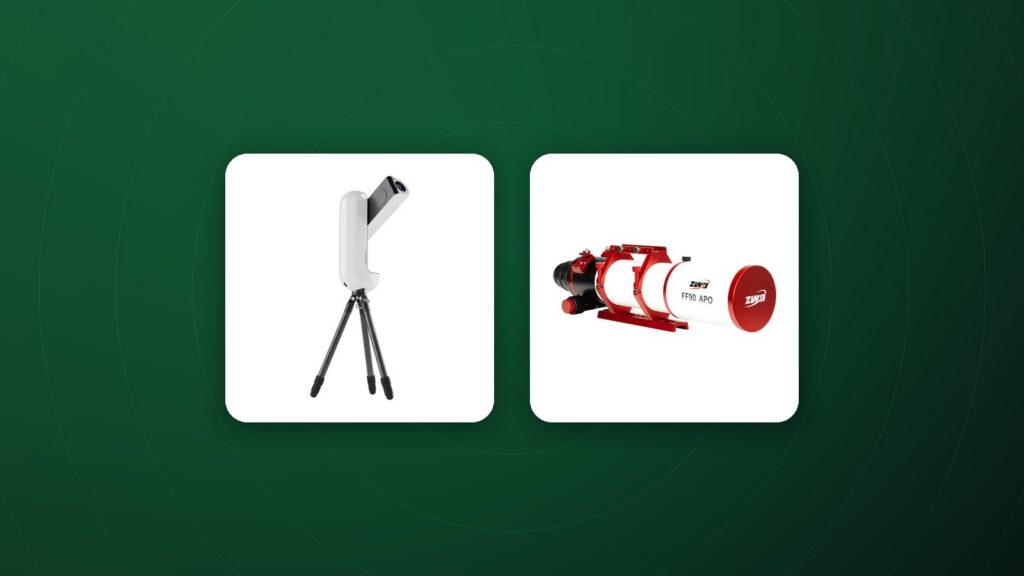
Digital telescopes combine an imaging sensor, automatic alignment and an app. They capture and stack images of nebulae and galaxies in real time and are ideal for beginners in light-polluted areas or anyone who wants images without learning complex astrophotography.
Eyepieces and accessories
A low-power eyepiece is best for finding objects; higher magnification is for the Moon and planets in steady air. A Moon filter, a red-light torch and a star-chart app make sessions more enjoyable.
Where and when to observe
- Let the telescope cool outside for 20 to 30 minutes.
- Give your eyes time to adapt to the dark.
- Observe planets when they are high in the sky for steadier views.
Understanding magnification
Magnification equals the telescope’s focal length divided by the eyepiece’s focal length. A 1,000 mm telescope with a 25 mm eyepiece magnifies 40x. Useful magnification is limited by aperture and atmospheric conditions.
Light pollution
City lights reduce contrast for faint objects. The Moon, planets and double stars remain great targets from cities, while dark sites reveal galaxies and nebulae.
Frequently Asked Questions
What magnification do I need to see Saturn’s rings?
Saturn’s rings are visible at modest magnification in most telescopes; steady air matters more than very high power.
Are smart telescopes good for beginners?
Yes. They are easy to set up and produce impressive images of deep-sky objects from home.
Refractor or reflector for a first telescope?
Both work well. Refractors are low-maintenance; reflectors offer more aperture for the money.
Can I use a telescope from a balcony?
Yes, though heat rising from buildings can affect views.
What can I see with a small telescope?
The Moon, planets, star clusters and bright nebulae are rewarding targets.
Shop telescopes
Explore optics including refractors, catadioptric telescopes and smart telescopes, with full specs and 60-day returns on eligible items.