Buying Guide
Refractor vs Reflector Telescope: Key Differences
The refractor vs reflector telescope decision shapes what you can see, how easy your telescope is to use and how much maintenance it needs. A third design, the catadioptric telescope, combines elements of both.
Refractor telescopes
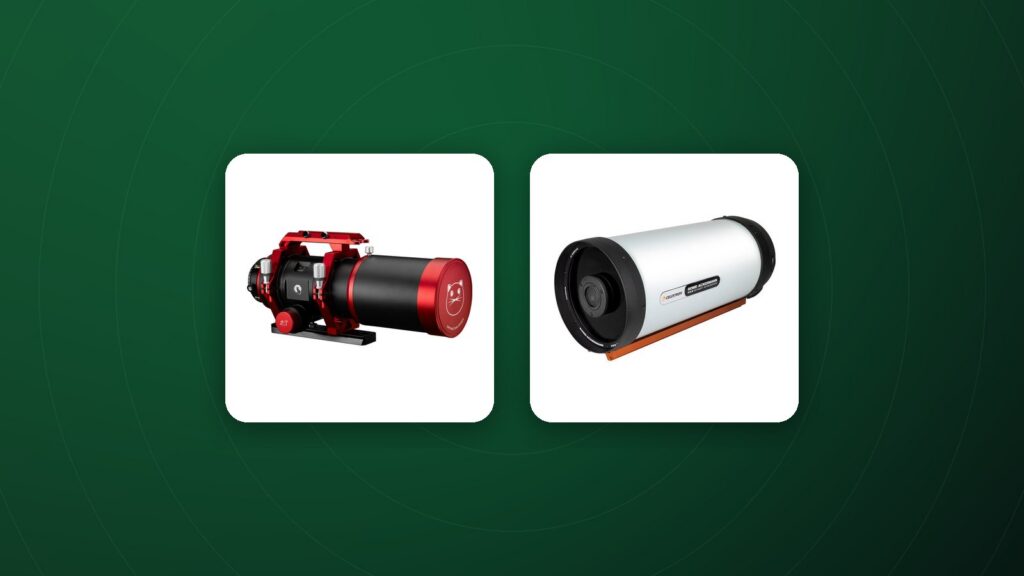
Refractors use lenses to gather and focus light. They have a sealed tube, need little maintenance and are ready to use quickly. Apochromatic (APO) refractors use special glass to minimise colour fringing, making them a favourite for astrophotography and high-contrast views of the Moon and planets.
Reflector telescopes
Reflectors use mirrors to collect light. They offer large apertures for the price, which helps reveal faint galaxies and nebulae. They need occasional collimation (aligning the mirrors), and their open tubes need time to cool to the outside temperature.
Catadioptric telescopes
Catadioptric designs, such as Schmidt-Cassegrain and Maksutov-Cassegrain telescopes, use both mirrors and lenses to fold a long focal length into a compact tube. They are popular for planetary viewing and portable observatories, and some astrograph versions are optimised for wide-field imaging.
Aperture: the most important specification
Aperture, the diameter of the main lens or mirror, determines how much light a telescope gathers and how much detail it can resolve. More aperture shows fainter objects, but also increases size and weight.
Mounts matter
A stable mount is essential. Alt-azimuth mounts are simple and intuitive; equatorial mounts track the sky’s motion and are preferred for astrophotography. Computerised GoTo mounts can find thousands of objects automatically.
Refractor
- Low maintenance
- Sharp, high-contrast views
- Excellent for astrophotography
- Smaller apertures for the cost
Reflector
- Large aperture for the price
- Great for faint deep-sky objects
- Needs collimation
- Bulkier tubes
Telescopes for astrophotography
Short focal length apochromatic refractors are popular for wide-field astrophotography because they are forgiving and easy to use. Catadioptric astrographs offer fast optics for capturing faint nebulae and galaxies.
Portability and storage
Consider where you will store the telescope and how far you will carry it. A smaller telescope that is easy to set up often gets used more.
Frequently Asked Questions
Which telescope is best for beginners?
A small refractor or a Dobsonian reflector are both excellent first telescopes, depending on whether you value portability or aperture.
Which is better for planets?
Quality refractors and Maksutov or Schmidt-Cassegrain designs are popular for crisp planetary views.
Can I do astrophotography with any telescope?
Yes, but a tracking equatorial mount and a telescope designed for imaging make it much easier.
What is collimation?
Collimation is aligning a telescope’s mirrors to ensure sharp images.
Do refractors need cooling?
Refractors usually cool faster than large reflectors due to their sealed tubes.
Shop telescopes
Compare refractor telescopes and catadioptric telescopes, with full specs and 60-day returns on eligible items.