
Buying Guide
Cine Lens vs Photo Lens: What Is the Difference?
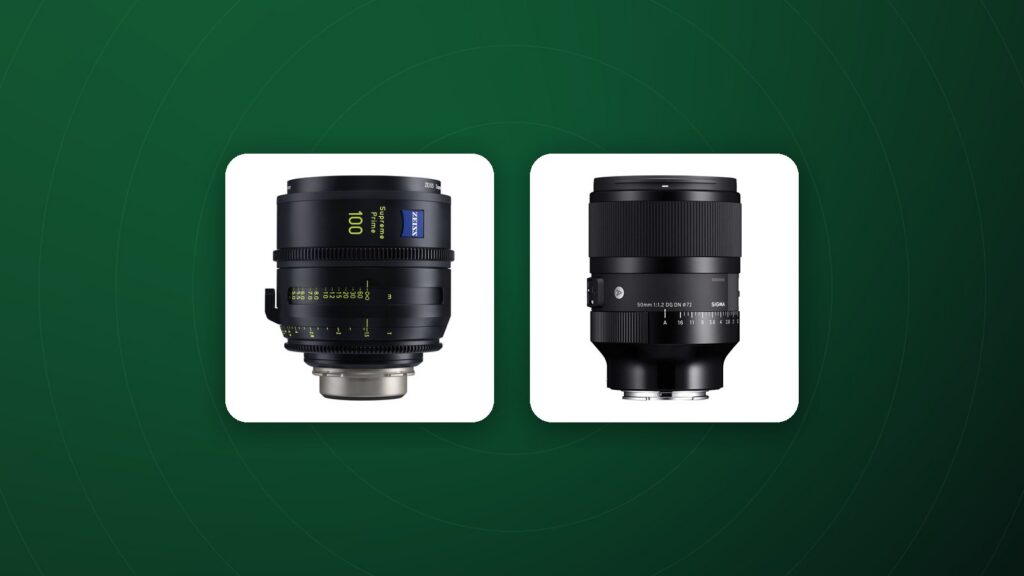
The cine lens vs photo lens question matters as soon as video becomes serious work. Both lenses project an image onto a sensor, but cine lenses are designed around the needs of film crews: precise, repeatable focus pulls, consistent exposure and matching looks across a set.
T-stops instead of f-stops
Photo lenses use f-stops, a theoretical measure of aperture. Cine lenses are marked in T-stops, which measure how much light actually reaches the sensor. Two cine lenses at T2 deliver the same exposure, which makes switching lenses during a scene seamless.
Long, smooth focus throw
Cine lenses have a long focus rotation, often close to 300 degrees, with clearly marked distance scales. That allows a focus puller to make precise, repeatable moves. Photo lenses usually have short throws designed for fast autofocus.
Geared rings and consistent positions
Focus, iris and sometimes zoom rings have gear teeth that engage a follow focus system or wireless motors. In a matched set, the gear rings sit in the same position on every lens, so accessories do not need to be moved when you change lenses.
De-clicked iris and minimal breathing
The iris on a cine lens moves smoothly without clicks, allowing exposure changes during a shot. Cine lenses are also designed to minimise focus breathing, where the framing shifts as focus changes.
Matched sets
Cine primes are usually built as sets with matching colour rendering, size and front diameter. That keeps the look consistent from wide shots to close-ups and makes matte boxes and filters easier to manage.
Mounts and build
Cine lenses commonly use PL or LPL mounts, though many are available in mirrorless mounts such as E, RF and L. Housings are typically metal and built for daily professional use.
When a photo lens is enough
For solo creators, documentaries and run-and-gun projects, photo lenses with fast autofocus and stabilisation are often the better tool. Many filmmakers start with photo lenses and move to cine lenses as their productions grow.
Cine zooms
Cine zoom lenses are designed to stay in focus while zooming (parfocal) and keep the image centred during zooms. They are popular for documentaries, live events and broadcast work, where changing lenses is impractical.
Rehousing photo lenses
Some manufacturers rehouse photo lens optics in cine-style bodies with geared rings, de-clicked apertures and consistent front diameters. This offers a cinema workflow with a more accessible price or a particular vintage look.
Building your first cine set
Many filmmakers start with three primes, such as a 25 mm, 50 mm and 85 mm in Super 35 or 35 mm, 50 mm and 85 mm in full frame. Add wider and longer lenses as productions require.
Frequently Asked Questions
Can I use cine lenses on a mirrorless camera?
Yes. Many cine lenses are available in mirrorless mounts, or you can use a compatible adapter.
Do cine lenses have autofocus?
Most do not. Focus is pulled manually or with wireless motors.
Why are cine lenses more expensive?
Matched optics, precise mechanics, robust housings and consistent T-stops across a set require more demanding design and manufacturing.
Are cine lenses sharper than photo lenses?
Not necessarily. Their advantages are consistency, mechanics and rendering, not just sharpness.
Can I use photo lenses with a follow focus?
Yes, with gear rings, although short focus throws make precise pulls harder.
Shop cine lenses
Compare primes, zooms and full sets in our digital cine lenses collection, with full specs and 60-day returns on eligible items.